
Who Are the Top TFT TV Manufacturers in China?

Time:2026-10-30 Author:Liam
0%

China’s TFT TV landscape is broad, but a brand name alone does not reveal who made the panel, assembled the set, or designed its software. TCL, Hisense, Skyworth, Changhong, Konka, and Xiaomi are among the Chinese brands buyers may encounter. Their products differ in screen sizes, backlight systems, picture processing, and after-sales support. A bright shop-floor image can impress; a dim living-room scene may tell another story. Small details matter.

Display analyst Ross Young, founder of Display Supply Chain Consultants, provides a useful lens on the industry. The following is an editorial paraphrase of his market-focused perspective, not a verbatim quotation: “Panel capacity matters, but it does not tell the whole TV story.” That distinction is easy to miss. Panel production, television manufacturing, and brand ownership are related, yet they are not interchangeable. Some companies make panels; others source them and focus on assembling or selling complete TVs. This overview examines leading Chinese manufacturers through those differences, while treating rankings carefully. Market position shifts, and public information does not always show the full supply chain. A neat top-ten list can therefore be misleading. The more useful question is what each maker actually controls—and how that affects the screen in your home.
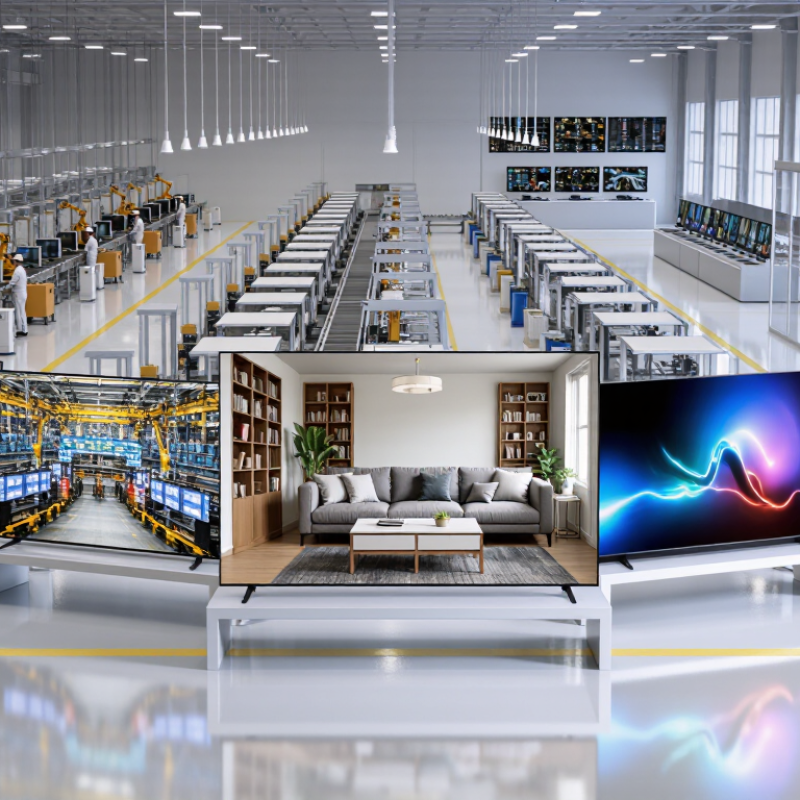
Who Are the Top TFT TV Manufacturers in China?

What TFT TVs Are and How Their Displays Work

A TFT television uses a thin-film transistor array to control the liquid crystals in its LCD panel. Each pixel contains red, green, and blue subpixels, while tiny transistors regulate how much light passes through them. A backlight supplies that light; the liquid crystals shape it rather than producing it themselves. Tiny switches matter. Their precise control helps create sharp edges in text and detailed scenes, though motion clarity also depends on refresh rate and response time.

Brightness and contrast depend on more than the transistor layer. Backlight strength, panel alignment, and dimming zones all affect what viewers see, especially in dark scenes. TrendForce forecast 195.8 million global TV shipments for 2024, illustrating the scale of the display market; that figure covers TVs overall, not TFT models alone. The term “TFT TV” can also be imprecise: TFT describes the pixel-control structure, not a complete display category. It is easy to focus on resolution and miss viewing angles or reflections. A practical comparison should include those details, plus how the screen looks in a bright room.

China’s TFT Television Manufacturing Landscape

China’s TFT television landscape is best understood as a connected production system, not a list of household names. It links panel fabrication, glass and driver components, backlight assembly, television integration, and export logistics. Omdia’s 2024 Display Long-Term Demand Forecast estimates that mainland China holds about 70% of global LCD panel production capacity. This concentration supports a deep supplier network and shorter sourcing routes. Still, capacity is not the same as quality or profitability. A large factory can produce millions of panels, but tuning motion, brightness, and color requires separate expertise. Not the whole story.

At the finished-TV level, China’s National Bureau of Statistics reported 193.5 million color television sets produced in 2023. A useful anchor. The figure does not separate TFT models, panel origins, or domestic sales. That distinction matters: televisions assembled in China may use components sourced across multiple regions. TrendForce’s 2024 global TV shipment outlook placed worldwide shipments near 195 million units, showing how export demand can influence factory schedules. Public statistics often group display technologies together, so comparisons require care. The landscape is large, but the available data does not make every part equally visible.

China’s TV Manufacturing Landscape: Annual Color-TV Output

Annual production of color television sets in China, in millions of units. This broad official production category is not limited to TFT-LCD models and does not identify individual manufacturers.

Source: National Bureau of Statistics of China, annual industrial production data. Values are shown in millions of sets.

Leading TFT TV Manufacturers in China

Leading TFT TV manufacturers in China combine panel sourcing, electronics assembly, and quality control. Their strength is not just scale. It is the ability to tune backlights, color settings, and motion processing for different price points. TrendForce estimated global TV shipments at about 196 million units in 2024, underscoring the volume pressure facing manufacturers. In practice, a consistent gray scale and clean edge detail matter as much as a large screen. Small flaws show quickly in dark scenes.

China’s manufacturing base benefits from concentrated LCD panel capacity and mature supplier networks, as described in Omdia’s display industry coverage. This can shorten sourcing routes, but it does not guarantee a better finished TV. Buyers should compare native contrast, peak brightness, refresh behavior, and warranty terms under the same test conditions. Ask for measured results, not only feature labels. A sample unit may look excellent in a bright showroom and disappoint in a dim room. That happens.

For procurement teams, leading suppliers are those that document panel grades, test uniformity across batches, and provide traceable production records. Request checks for dead pixels, backlight bleed, and input lag. Also confirm firmware support and replacement-part availability. These details are less glamorous. They often determine whether a TFT TV performs reliably after installation.

Who Are the Top TFT TV Manufacturers in China? - Leading TFT TV Manufacturers in China

This overview describes major manufacturer types and capabilities in China’s TFT television supply chain. Company and brand names are intentionally omitted; the categories below are not a company-by-company ranking.

Manufacturer Category Main Manufacturing Role Typical Products and Technologies Relevant Production Capabilities Industry Context
Large-scale television set manufacturers Design and assemble finished televisions, integrating display modules, electronics, software, and enclosures. TFT-LCD televisions with LED backlights; common product formats include Full HD and 4K UHD, with higher-resolution models also available. High-volume final assembly, product testing, packaging, and coordination of component suppliers. Finished-TV production is distinct from making the TFT-LCD panel itself; manufacturers may source panels from external suppliers.
Panel-integrated television manufacturers Combine television assembly with access to in-house or affiliated display-panel production. LCD television products using TFT backplanes and liquid-crystal cells; panel implementations can include different alignment and backplane technologies. Closer coordination of panel specifications, display-module assembly, and finished-TV production. Vertical integration can support supply-chain coordination, but does not by itself establish product quality or market leadership.
Display-panel manufacturers Fabricate TFT arrays and LCD panels or supply display cells and panels to module and television assemblers. Large-area TFT-LCD panels used in televisions; common LCD backplane approaches include amorphous-silicon and oxide TFT. Panel fabrication, cell processes, inspection, and panel cutting to suit different screen sizes. Panel makers are an upstream part of the TV supply chain and do not necessarily sell finished televisions under their own names.
Display-module manufacturers Turn LCD panels into display modules by integrating components such as backlights, frames, and driver electronics. LCD modules for television sizes and resolutions; LED backlighting is widely used in LCD televisions. Module assembly, backlight integration, optical inspection, and functional testing. A module is not a complete television: a finished set also needs a main board, power system, enclosure, software, and other components.
ODM and contract manufacturers Provide product engineering, sourcing, or assembly services for television products designed for other sellers. LCD TV platforms configured to customer specifications, including variations in screen size, resolution, connectivity, and software. Manufacturing flexibility, supplier coordination, customization, and production scaling across product programs. ODM and contract-manufacturing roles may overlap with finished-TV assembly, and commercial arrangements are often customer-specific.
Technology reference points Common display specifications used across the television supply chain. 4K UHD is 3,840 × 2,160 pixels; 8K UHD is 7,680 × 4,320 pixels. LCD televisions use a TFT array to control individual pixels. Panel resolution, screen size, refresh rate, contrast, color performance, and backlight design are evaluated as separate specifications. These are industry technology facts, not output figures or rankings for any particular manufacturer.

How China’s Top TFT TV Manufacturers Compare

When comparing China’s leading TFT TV manufacturers, look beyond screen size and advertised resolution. Their differences often appear in panel tuning, backlight control, assembly consistency, and after-sales support. A bright showroom image can look impressive, but home viewing may reveal uneven blacks or glare. Check how a set handles subtitles, sports motion, and dim scenes. Small details matter.

Manufacturers may use different panel suppliers and picture-processing methods, even within similar price ranges. That can affect color accuracy, viewing angles, and how smoothly fast scenes appear. Compare measured brightness and contrast when reliable test data is available, rather than relying only on peak claims. Also inspect ports, menu response, and whether settings are easy to adjust. These are ordinary checks, not glamorous ones.

Build quality is more than a thin bezel. Look at panel uniformity, stand stability, heat around ventilation slots, and warranty clarity. Strong quality control can mean fewer surprises between units, though production variation never disappears entirely. I would be cautious about treating one review as proof of every model’s performance. Retail samples and long-term ownership can tell different stories. For buyers, the best comparison is model-specific: test the picture in a familiar room, then weigh support against price.

Industry Trends Shaping Chinese TFT TV Makers

Chinese TFT TV makers are competing in a mature market, where panel size alone no longer guarantees a sale. TrendForce’s August 2024 forecast put global TV shipments at 195.8 million units, just 0.2% above 2023. That near-flat outlook makes cost control and visible product upgrades especially important. Makers are refining backlighting, picture processing, and software while keeping large-screen models affordable.

Mini LED is one notable direction. TrendForce forecast 6.9 million Mini LED TV shipments worldwide in 2024, a 67% year-on-year increase. For Chinese manufacturers, this creates room to offer finer local dimming and stronger contrast without relying solely on premium panel technologies. But shipment forecasts cannot show whether viewers notice the improvement in a bright living room. That matters. Power use, repairability, and consistent picture quality still deserve more attention; industry marketing can sometimes move faster than measured benefits.

Tips: Compare screen size, brightness, and energy use under similar conditions. Ask how local dimming performs in dark scenes, not just on a vivid showroom loop. A specification sheet helps, but it is not the whole experience.

FAQS

What does TFT mean in a television?

TFT means thin-film transistor. Tiny switches control the liquid crystals in an LCD panel. Tiny switches matter.

How does a TFT screen create an image?

A backlight provides the light. The liquid crystals shape it, while red, green, and blue subpixels combine to form colors.

Does a TFT panel produce its own light?

No. It relies on a backlight. The panel controls how much light passes through each pixel.

What affects picture quality besides resolution?

Backlight strength, panel alignment, dimming zones, and reflections all matter. Viewing angles can matter too, especially in a bright room.

Does TFT alone determine motion clarity?

No. Refresh rate and response time also affect moving images. A detailed picture can still look blurred during fast scenes.

Is “TFT TV” a complete display category?

Not exactly. TFT describes how pixels are controlled, not every feature or performance level of a television. The label can be vague.

How large is China’s role in LCD panel production?

One 2024 industry forecast estimated mainland China held about 70% of global LCD panel production capacity. Capacity does not guarantee quality or profit.

What do television production figures tell us?

China reported 193.5 million color television sets produced in 2023. The figure does not identify TFT models, panel origins, or domestic sales.

Do global TV shipment forecasts count only TFT televisions?

No. A 2024 forecast placed worldwide TV shipments near 195.8 million units overall. It did not isolate TFT models. That distinction is easy to miss.

Conclusion

This article explains what a Tft Tv is and how its display turns electronic signals into images through a grid of pixels controlled by thin-film transistors. It then explores China’s television manufacturing landscape, where established production capabilities, supply-chain networks, and ongoing investment in display technology support a wide range of products. Rather than focusing on individual brand names, the article describes the kinds of manufacturers involved and the factors that help them serve different markets.

The comparison considers manufacturing scale, display performance, product variety, energy efficiency, and research and development. It also examines trends shaping the industry, including demand for higher resolutions, larger screens, smarter features, and more efficient production. Together, these topics offer a broad view of how Chinese manufacturers compete and adapt as consumer expectations and display technologies continue to evolve.

Liam

Liam

Liam is a dedicated marketing professional with a profound expertise in the industry, where he excels at highlighting the unique advantages of our core products. With a keen understanding of market trends and consumer needs, Liam frequently updates our company’s professional blog, providing......